
Postpartum Pelvic Floor Exercises for Healing & Aftercare
Author: Dr. Tara Morrison
Postpartum pelvic floor recovery is about more than doing endless Kegels. The right approach depends on your activity goals, how birth went for you, and how your body feels in those first days, weeks, and months after delivery. There is no one-size-fits-all path to healing, and expert guidance from a pelvic floor physical therapist who specializes in postpartum recovery should be the standard of care for every new mother.
In this article, we'll explore what happens to the pelvic floor after birth, safe early movements and exercises, the benefits of pelvic floor therapy, and when to seek professional help. Whether you had a vaginal birth or a cesarean, aligned postpartum support builds the foundation for pelvic health and core strength through subsequent pregnancies - and well into perimenopause and beyond.
What Happens to the Pelvic Floor After ChildBirth?
The pelvic floor is a group of muscles at the base of your pelvis that support the bladder, bowel, and uterus. They work in sync with your respiratory diaphragm to stabilize your core, pump lymphatics and blood through your body, and support healthy digestion.
During the second stage of labor, these muscles stretch 200-300% of their normal resting length. Research published in the Annual Review of Biomedical Engineering found the stretch ratio can reach as high as 3.26 by the end of second stage - an event unlike almost any other in the body's biomechanical history (Ashton-Miller & DeLancey, 2009). And even with a cesarean birth, your pelvic floor underwent significant stretching throughout pregnancy.
Recovery begins after baby arrives, but while most recoil happens in the first six weeks, it can take six months to a full year for tone and function to normalize. Tearing, vacuum or forceps delivery, or a long pushing stage can extend that timeline further.
In the early weeks, pelvic heaviness or pressure is your body's signal to rest. Pushing through it can contribute to pelvic organ prolapse (POP) - when the bladder, rectum, or uterus begins to descend into the vaginal canal. Research suggests 30-70% of postpartum women have some degree of prolapse on examination (Ashton-Miller & DeLancey, 2009).
A note on cesarean births:Pelvic floor PT is essential after a C-section - for scar tissue management, restoring tone from pregnancy, and addressing any changes that began during labor before surgery.
A note on Kegels: Not every postpartum pelvic floor needs more strengthening. Muscles can also be tight, overactive, or poorly coordinated. Symptoms like incontinence, constipation, or pressure may signal tension, not weakness - and aggressive Kegels can make those symptoms worse.
Common symptoms worth addressing:
Urinary leakage
Pelvic heaviness or pressure
Pain with movement or intimacy
Difficulty relaxing or contracting the pelvic floor
Constipation or trouble controlling gas or poop
Feeling of instability through the core
When Can You Start Pelvic Floor Exercises After Pregnancy?
Gentle, breath-based awareness work can begin in the early days if comfortable. More structured strengthening typically comes after your six-week clearance - but let's talk about what "cleared" actually means.
Too often, new mothers hear "you're cleared for exercise" and jump back into their pre-baby routines, only to develop dysfunction from moving too fast. I encourage women to think of postpartum as an opportunity to rebuild from the ground up. Your body spent nine months growing and adapting - it doesn't reset in six weeks. A phrase I come back to often: nine months in, nine months out.
Timeline Framework
Days 1-7:The goal is not to bounce back. It's to reconnect to your breath, support healing, and protect recovering tissues. Focus on rest, diaphragmatic breathing, gentle pelvic floor awareness, and walking only as tolerated.
Weeks 2-6:Add gentle pelvic floor contractions if pain allows, breath-coordinated core engagement, gentle stretching, short walks, and scar or perineal healing awareness.
Around 6 Weeks: Check in with your OB-GYN, midwife, or pelvic floor PT. This is an ideal time to start pelvic floor PT. Progress exercise based on symptoms, delivery type, and provider guidance.
Weeks 6-12: Begin more structured strengthening - coordination between breath, deep core, and pelvic floor, and functional movements like bridges, sit-to-stand, and supported squats.
Important Note: Anyone experiencing severe pain, heavy bleeding, prolapse symptoms, or significant incontinence should speak with a qualified provider before progressing.
Benefits of Postpartum Pelvic Floor Exercises
Consistent pelvic floor rehabilitation helps you rebuild a strong, responsive foundation - whether you're planning another pregnancy, returning to athletic training, or simply want to move through daily life without leaking or discomfort. A 2024 systematic review in BMJ Open found postpartum pelvic floor muscle training significantly reduced the prevalence of urinary incontinence and pelvic organ prolapse, consistent with the International Continence Society's Grade A recommendation that training be offered as first-line care for all postpartum women (Padoa et al., 2024).
Benefits include improved bladder control, better pelvic organ support, core and pelvic stability, reduced heaviness and pressure, stronger recovery, improved body confidence, better sexual function and orgasm, safer return to exercise, and reduced risk of long-term dysfunction.
Examples of Pelvic Floor Exercises After Childbirth
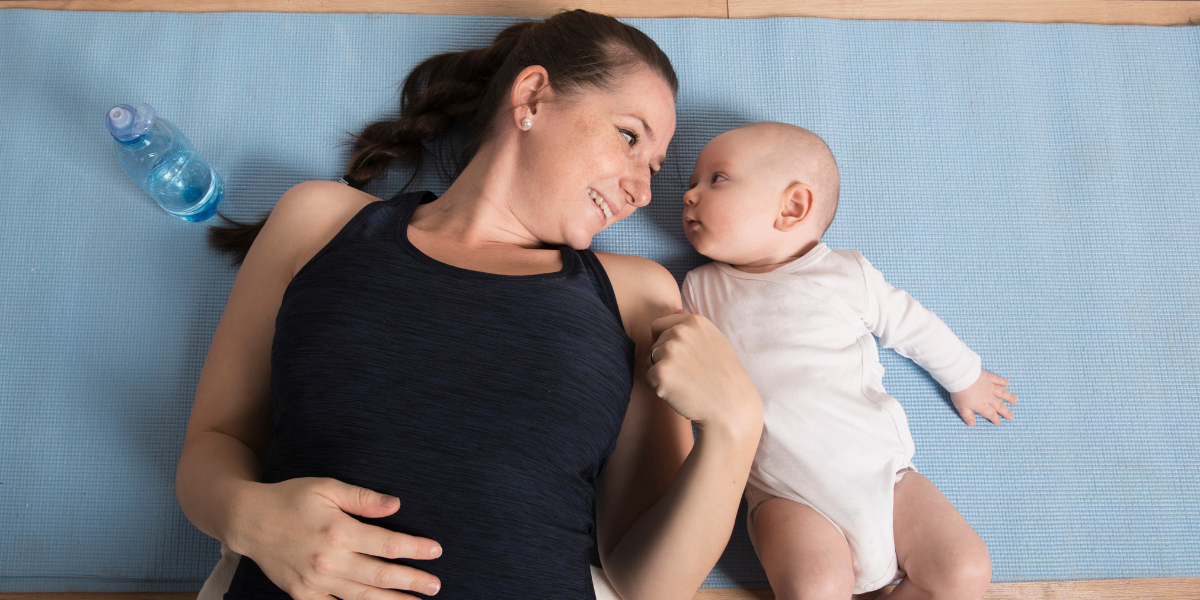
These movements are gentle by design and appropriate for most postpartum bodies in the early weeks. If any exercise causes pain, heaviness, increased bleeding, or worsening leakage - stop and consult a pelvic floor PT.’
1. Diaphragmatic Breathing
The pelvic floor-diaphragm relationship is the foundation of core stability, digestion, and circulation. Safe to begin on day one.
Lie on your back, side, or sit comfortably.
Inhale through the nose, letting the ribcage and belly expand fully.
Imagine the pelvic floor blossoming open like a flower - gently releasing downward.
Exhale slowly and feel a gentle gathering and lift, as if the flower softly closes.
Repeat 5-10 breaths.
2. Pelvic Floor Connection Breath
Focuses on a gentle internal lift without gripping the glutes, bracing the thighs, or holding the breath.
Note: If you have high resting tone, pelvic pain, or symptoms that worsen with Kegels, work with a PT before continuing.
Inhale and allow the pelvic floor to fully relax and bloom open.
On the exhale, gently lift - imagine drawing a tissue upward out of a tissue box with your vagina.
Keep glutes, inner thighs, and jaw relaxed.
Hold briefly, fully release. Repeat 5-10 times.
3. Blow Before You Go
Deep core muscles are reflexive - designed to activate before movement. This trains that anticipatory engagement, essential when you're lifting and carrying a newborn all day.
Before any movement (picking up baby, standing, squatting): pause and prepare.
Inhale to set up.
Exhale through pursed lips as if blowing up a balloon.
Feel the pelvic floor gently lift and the lower belly softly draw in.
Maintain that engagement through the movement.
4. Heel Slides with Core Connection
Adds gentle functional core work while reinforcing the breath-movement connection.
Lie on your back with knees bent.
Exhale and engage the pelvic floor and deep core using "Blow Before You Go."
Continue breathing naturally while you slowly slide one heel away, then return.
Switch sides. Repeat 8-10 times per side.
5. Glute Bridge
Supports the hips and posterior chain while integrating core engagement.
Lie on your back with knees bent and feet flat.
Exhale and gently engage the pelvic floor.
Lift hips slowly, just a few inches. Lower with control.
Repeat 8-10 times if symptom-free.
6. Supported Squats / Sit-to-Stand
Trains pressure management during the daily tasks you're already doing.
Inhale to prepare.
Use "Blow Before You Go" - exhale, engage pelvic floor and core.
Continue the exhale as you stand or lower into the squat.
How Often Should You Do Pelvic Floor Exercises After Birth?
Consistency matters more than intensity. Even 5-10 minutes of intentional movement each day makes a real difference. Integrate your baby when you can - diaphragmatic breathing while baby rests on your chest, or heel slides next to baby during tummy time.
My best advice: during baby's first nap of the day, before the dishes or the to-do list, take 15-20 minutes just for you. Sleep if you need it. Otherwise, give those moments to movement, breath, and reconnecting with your body.
Signs You May Need a Pelvic Floor Physical Therapist
Postpartum pelvic floor therapy should be the standard of care for every mother - not just those with symptoms. In France, it already is: all postpartum women are prescribed 10-20 sessions of rééducation périnéale (perineal reeducation) regardless of symptoms, fully covered by the state since 1985 (McMahon, 2024). The United States has not caught up, which means you have to advocate for yourself.
Seek pelvic floor PT if you have any of the following: urinary leakage beyond early healing, pelvic pressure or bulging, persistent pain, pain with sex, constipation or bowel dysfunction, difficulty engaging or relaxing the pelvic floor, C-section scar discomfort, uncertainty about your technique, or diastasis recti.
Postpartum symptoms are common - but they are not something you simply have to live with. You deserve to feel strong, connected, and at home in your body as a mother.
Postpartum Recovery Tips Beyond Exercises
Rest and sleep when possible
Avoid straining with bowel movements - use a footstool to encourage a natural squat position
Stay hydrated and prioritize fiber
Use good lifting mechanics and exhale on effort
Progress gradually back into impact exercise
Seek individualized guidance when symptoms arise
Final Thoughts
Your pelvic floor journey will be as unique as you are. Research continues to highlight the value of individualized, supervised care for reducing urinary incontinence and preventing long-term dysfunction (Padoa et al., 2024; Lemos et al., 2008). Don't wait for something to feel wrong before paying attention. And don't accept "this is just part of being a mom" as the end of the conversation.
You deserve to feel strong, connected, and fully alive in your body - and it starts here.
References
Ashton-Miller, J. A., & DeLancey, J. O. L. (2009). On the biomechanics of vaginal birth and common sequelae. Annual Review of Biomedical Engineering, 11, 163-176.https://pmc.ncbi.nlm.nih.gov/articles/PMC2897058/
Lemos, A., de Souza, A. I., Ferreira, A. L. C. G., Figueiroa, J. N., & Cabral-Filho, J. E. (2008). Do perineal exercises during pregnancy prevent the development of urinary incontinence? A systematic review. International Journal of Urology, 15(10), 875-880.https://pmc.ncbi.nlm.nih.gov/articles/PMC12303446/pdf/medi-104-e43554.pdf
McMahon, F. (2024). Pelvic floor reeducation in France: Ooo la la la. Beyond Basics Physical Therapy. https://beyondbasicsphysicaltherapy.com/blog/ooo-la-la-la-reeducation-perineale-pelvic-floor-en-france
Padoa, A., McLean, L., Morin, M., & Bazi, T. (2024). Impact of postpartum exercise on pelvic floor disorders and diastasis recti abdominis: A systematic review and meta-analysis. BMJ Open.https://pmc.ncbi.nlm.nih.gov/articles/PMC12013572/
About the Author

Tara Morrison is a Doctor of Physical Therapy and pelvic health specialist, with advanced training in pelvic floor rehabilitation, perinatal care, trauma-informed practice, somatic healing, and quantum spine care.
She is the founder of Sacred Bloom Pelvic Care, where she integrates evidence-based pelvic physical therapy with somatic awareness, fascia and spine-based work, and nervous system education to support pregnant and postpartum women with pain, birth recovery, bladder and bowel concerns, core dysfunction, and intimacy challenges.